


News

TEL:18925129293


Application of Vacuum Stirring Defoaming Machines in Defoaming of Lithium-ion Battery Anode Materials
date:2026-09-17author:小施Against the backdrop of global acceleration toward low carbonization and electrification, the lithium-ion battery industry is booming and has become one of the core pillars in the energy sector. As a critical component determining the overall battery performance, lithium-ion battery anode material directly affects the battery's energy density, charge-discharge efficiency, cycle life and safety. Nevertheless, bubble issues persist throughout the preparation process of anode materials, forming a major bottleneck restricting product upgrading. With outstanding technical principles and remarkable efficacy, vacuum stirring defoaming machines provide a powerful solution to tackle this challenge and deeply empower technological innovation in the lithium-ion battery anode material industry.
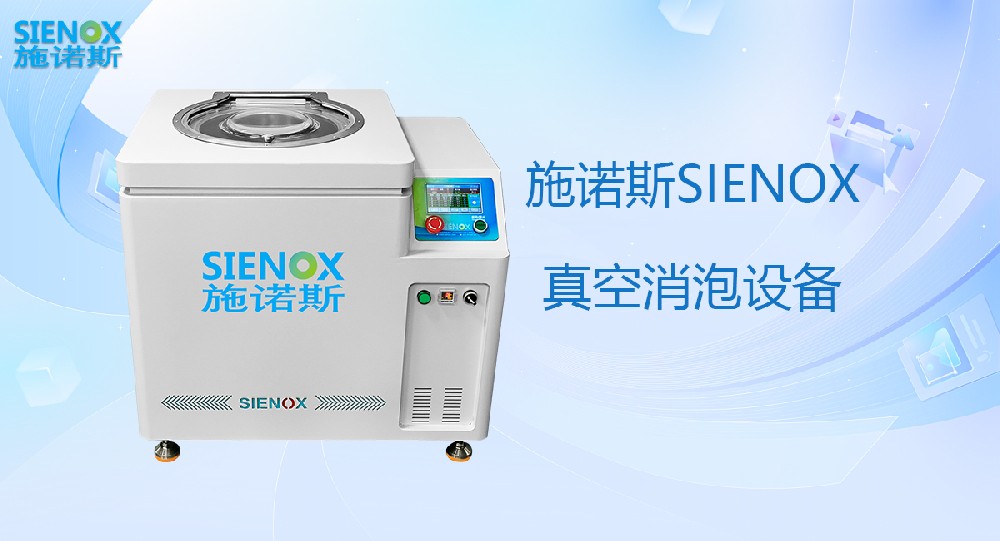
Working Principle of Vacuum Stirring Defoaming Machine: Efficient Defoaming Mechanism Integrated with Cutting-edge Technology
Tailored for lithium-ion battery anode materials, vacuum stirring defoaming machines adopt a highly precise and sophisticated defoaming system. Abandoning conventional simple stirring structures, they innovatively apply a multi-axis linkage adaptive rotating architecture. Once the anode slurry, accurately proportioned with graphite, silicon-based compounds, polymer binders and functional additives, is fed into the machine chamber, the intelligent multi-axis rotating system activates immediately. On one hand, powerful centrifugal force generated by high-speed revolution hurls the slurry toward the chamber wall. The slurry rolls repeatedly and stretches under high-speed turbulence, breaking the original microscopic steady state of the slurry and exposing hidden bubbles. On the other hand, the rotating component precisely adjusts the rotating speed according to preset programs and generates microscopically scalpel-like shear force to cut large bubbles into tiny ones, greatly lowering the difficulty of bubble separation.
Meanwhile, the matched high-performance vacuum pump continuously extracts air from the chamber to create an extreme high-vacuum negative pressure environment. Under normal pressure, the high viscosity of anode slurry and strong restraining force from surface tension trap bubbles and make them hard to escape. In vacuum conditions, the pressure difference inside and outside bubbles rises exponentially. Bubbles gain high kinetic energy, quickly migrate to the slurry surface and finally break through surface tension to realize deep and efficient defoaming. This dynamically optimized mode combining multi-axis rotation and vacuum extraction ensures high precision and efficiency of the defoaming process.
Substantial Performance Improvement of Lithium-ion Battery Anode Materials
Breakthrough promotion of electrochemical performance: Bubbles in the microscopic structure of anode materials act like chaotic "electronic thorns", severely blocking lithium-ion transmission paths, slowing down battery charge and discharge and reducing capacity utilization. After treatment by vacuum stirring defoaming machines, the internal material structure is reconstructed into a compact and regular form, building an unobstructed "superhighway" for lithium ions. Accordingly, the initial charge-discharge efficiency of the battery can steadily rise from 60%-70% affected by bubbles to over 80%, and the cycle life is significantly extended, supplying stronger, longer-lasting and stable power for high-end scenarios such as electric vehicles and distributed energy storage systems.
Enhanced structural stability of materials: During charge-discharge cycles, anode materials undergo periodic volume expansion and contraction. If bubbles remain inside the material, they act like hidden "structural time bombs". Stress from volume variation easily triggers material cracking and pulverization, leading to sharp degradation of battery performance. Defoamed materials feature a dense and solid internal structure, serving as an impenetrable protective armor to withstand volume changes during charge and discharge, maintain the integrity and stability of electrode structure and guarantee long-term efficient and stable battery operation.
Excellent optimization of processing adaptability: Anode slurry full of bubbles has a complicated gas-liquid two-phase structure and poor rheological properties. It cannot uniformly and stably cover the current collector in the coating procedure, resulting in uncontrollable electrode thickness uniformity and large dispersion of electrode performance. With unique defoaming and rheology regulation functions, vacuum stirring defoaming machines optimize the rheological behavior of slurry. The slurry spreads smoothly and evenly during coating, controlling electrode thickness consistency within tiny tolerances and stabilizing performance. Production yield is greatly improved, reject rate drops sharply, and cost loss caused by poor process adaptability is effectively reduced.
Fine Control Points in Practical Operation
Precise pre-mixing of raw materials: Weigh graphite, silicon-based compounds, polymer binders and other components accurately with high-precision electronic scales. Load materials into professional pre-mixing equipment such as planetary mixers and run at low and steady speed to fully disperse and blend all ingredients, laying a solid foundation for the subsequent defoaming procedure. Uneven graphite dispersion during pre-mixing easily forms local high-concentration agglomerates. It not only increases the difficulty of subsequent defoaming, but also leaves hidden risks affecting final material performance.
Careful feeding operation: Treat pre-mixed slurry as high-precision research samples and pour it slowly, steadily and accurately into the vacuum stirring defoaming machine. Hasty and rough feeding should be avoided to prevent generating excessive new bubbles and adding complexity to the defoaming process. Meanwhile, fully inspect the sealing device of the machine to meet strict process standards, eliminate risks of vacuum leakage and ensure stable defoaming results.
Intelligent and precise parameter tuning: Set parameters carefully on the machine control panel according to key characteristics of anode slurry including viscosity range, solid content and bubble distribution. Stirring speed is dynamically adjusted based on slurry viscosity, generally ranging from 400 to 1800 rpm. Stirring duration is customized according to bubble content and slurry properties, normally between 0 and 10 minutes. The vacuum degree should be stably maintained at -99.9KPa. For challenging high-viscosity slurry, appropriately extend stirring and defoaming time to achieve deep bubble removal.
Real-time process monitoring: During defoaming, observe dynamic changes of slurry in real time through the high-transparency observation window equipped on the machine. If the slurry churns excessively violently or suddenly stops rolling, adjust relevant parameters promptly according to professional judgment. Continuously monitor vacuum readings and the operational stability of the stirring motor to keep the whole machine running reliably.
Standardized discharging procedure: When reaching the preset defoaming time, wait until the vacuum reading returns to normal pressure, then carefully open the discharge port and collect high-quality defoamed slurry. The slurry should be fine, homogeneous and visually bubble-free, ready to be delivered to the subsequent electrode forming process for efficient preparation.
With the continuously rising global demand for clean energy and accelerated technological iteration, the lithium-ion battery anode material industry is advancing toward broader development. Featuring outstanding defoaming performance and deep material performance enhancement, vacuum stirring defoaming machines have become one of the core key equipment driving the vigorous development of this industry and helping the sector reach new technical heights, delivering continuous power for the sustainable development of the new energy industry.
Related recommendations
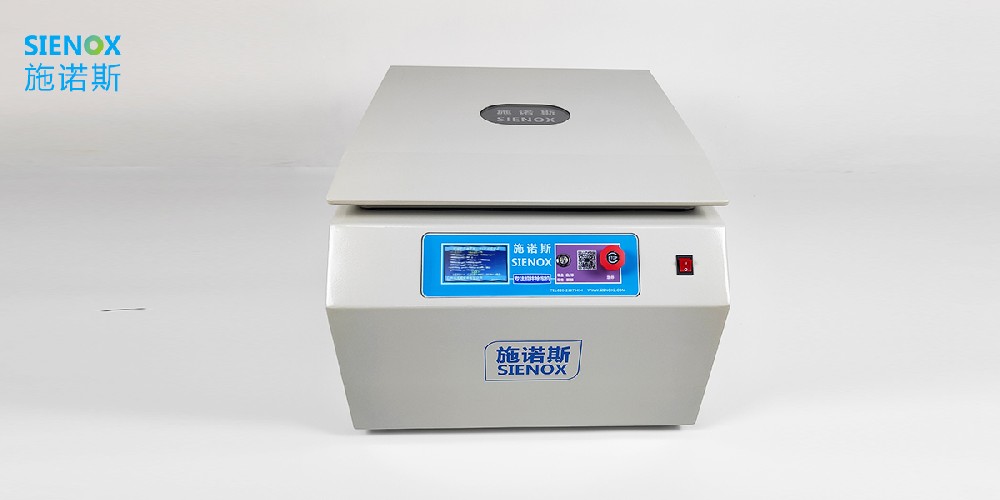
Centrifugal defoaming machine: An efficient tool for both laboratory and factory.
The extensive application fields of planetary defoaming machines.
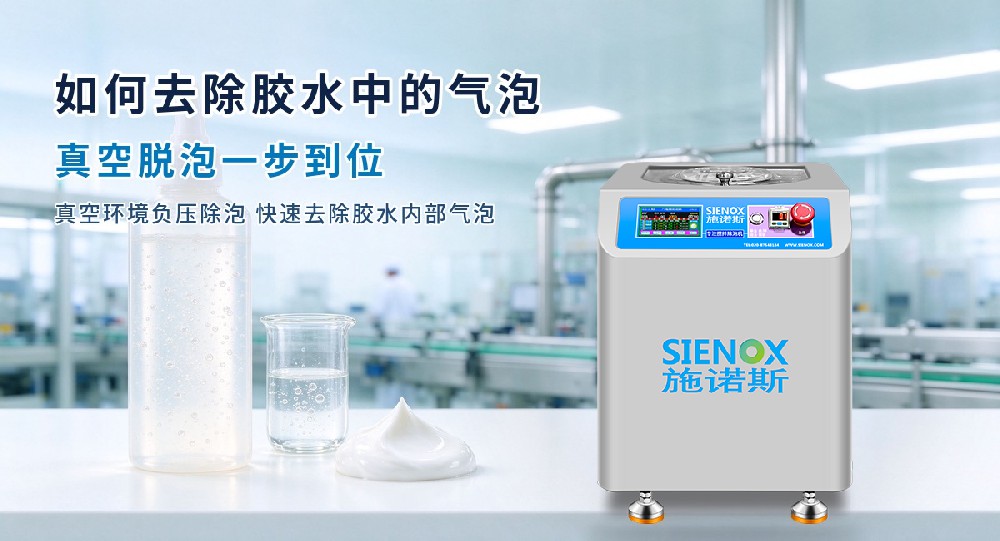
How to remove bubbles from glue
The application of vacuum stirring defoaming machine in the defoaming process of silver paste materials.
Perhaps you still need....
行星式真空脱泡搅拌机 SIE-MIX1000plus
实验室行星式搅拌脱泡机 SIE-SV200
SIENOX行星式脱泡搅拌机 SIE-CV300
离心脱泡机 SIE-C006
About SIENOX
广州施诺斯(SIENOX),20年脱泡机设备研发与生产的源头厂家
超过1800种材料脱泡案例
纳米级脱泡,满足不同材料多段搅拌除泡需要,支持定制
资质齐全,荣获多项国家专利,联系我们可免费试样